

Doing vs. Thinking
On riding a bike through Yellowstone

* ˚ ✦ East/West is a newsletter about the cultural roots of wellness and the tangible effects of wellbeing. Thank you for sharing, clicking ♡, and commenting on this post — you are keeping this project alive.
Once a year, in spring, the national park closes its roads to cars. The cyclists take over. When Madison and I arrived in Yellowstone around 9 a.m., we encountered a zoo of cyclists strutting about in technicolor clothes. One woman dressed as a banana peel walked past me to use the bathroom before her ride. Another lady donned a sequined blazer. She spoke in gestures to her gangling friend, who was dressed as a cheetah.
I have lived in a mountain town long enough to become inured to this phenomenon. The premise is simple: twenty and thirty somethings dress in outlandish costumery to do recreational activities, like ski and bike.


Madison and I pack our panniers while I pondered the decision to wear silly clothes on a 50-plus mile bike ride through grizzly and bison lands. I believe it has something to do with self-hedging, not wanting to be seen as too “hardcore,” which many people around these parts simply are. They run 100-mile races and parachute down cliffs. The costumes take a bit of the edge off.
Of course, I was engaging in my own form of silliness: I was riding an e-bike.
My reasons were simple. I wanted to ride with Madison and Madison wanted to take e-bikes. She had done this before and mentioned that she had seen many more megafauna, mostly wolves, grizzlies, and elk, because she was able to cover twice the distance. I didn’t mind, though I had never operated an e-bike before. Once we got started, I found the e-bike to be like a dirt bike, but more languid and soft. I liked the way the soft rubber wheels skimmed the asphalt.
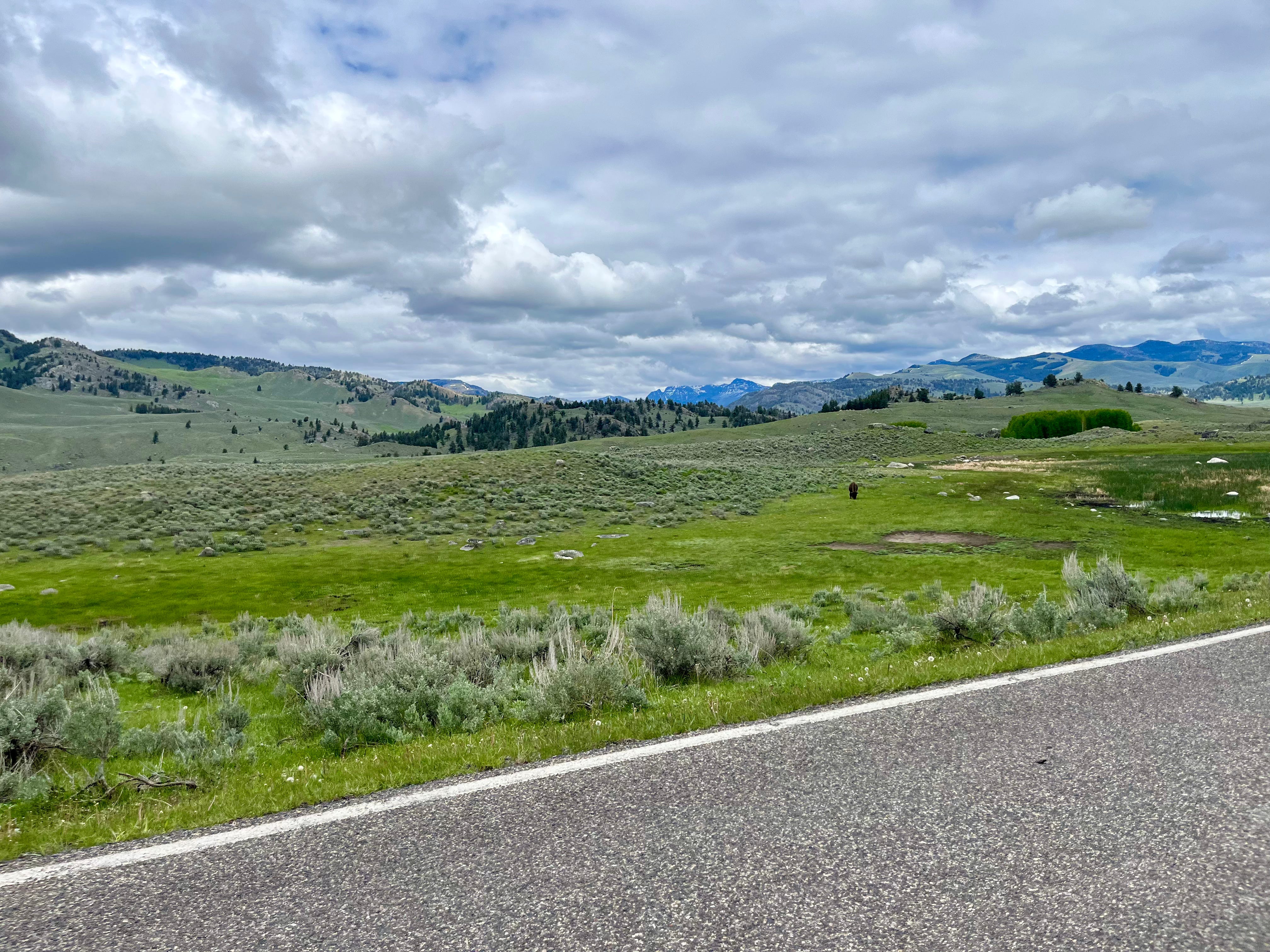
The roads were ours and ours alone. We rode through an alien valley of stones and then up a canyon ascent. We found ourselves at the top of a waterfall. From there we entered the Swan Lake Flats: a long, flat, and open plain broken by delicate foothills. Mountain peaks rose like little blue crowns above, and in the distance we saw the red faces of sandhill cranes nesting their eggs.
From time to time we’d pass an entourage of cyclists, and sometimes they would smirk in our direction, as if what we were doing was cheating, or a cop out, or wrong. I didn’t mind, because to me we were both doing different versions of the same thing: for them, something on the surface silly, but at its core quite difficult; for us: something on the surface intense, but at its core quiet facile.
As we rode, I found myself contemplating my life, that is the permission my life has given me to casually bike through the North American Serengeti on an idle Saturday. I felt more than simple gratitude: I felt an overwhelming sense that I was so immersed in the action of my life, so caught up in the acts of doing.
Since moving Montana, I have experienced a profound shift in my personal ratio of thinking to doing. Before, when I lived in Chicago, I spent 80% of my time in my head, thinking and reading and thinking about what I read and then writing and then thinking about what I wrote. I would discuss all of this with friends, with a sprinkle of discussion about our love lives, and then I would slip back into my inner world, read some more, and dream quiet, wordless dreams.
Then I moved to Montana and life began happening to me. This made me deliriously happy. But then, in time, my thinking time narrowed. It wasn’t necessary but it did happen, and I am trying to locate a sense of balance with that.
Life here is premised on doing. Like the cyclists in the parking lot, people here love to bike and ski and fish and hunt and run and all the other ways one can iterate one’s body across a landscape. It is, for some many who choose to live in mountain towns, their joie de vivre.
There’s nothing wrong with so much doing. But there’s a cost when doing becomes the whole point, in the same way that something dies when thinking reigns. Life, I think, is about calibration.
On the way home, while revisiting the Swan Lake Flats, the sandhill cranes posed in the distance, unwitting subjects of this American Western tableau. I gazed up at the colors of the cliffs and their moss, the ochres and indigos and ambers. I asked myself, what exactly are these colors? I tried to put names to them all.
But then, in a flash, the colors were behind me. I was trying to remember them, to name them, but I found myself back at the waterfall, and then the parking lot. That’s the thing about e-bikes: they move fast. It’s easy to get caught up in the motion, the energy, the flow.
For days after, I wished myself back to that moment, back to the flats. I wished that I had stopped my bike and just stood. It was cold, and a storm had arrived, but it would have been a moment to think, to allow the image’s meaning to be revealed.
It’s a pleasure to have so much to do. But the measure of health isn’t in one or the other. It’s in the dance between the two, in finding equilibrium. ✦˚*
Related Reading:

The Garden Vs. The Machine

* ˚ ✦ East/West is a newsletter about the cultural roots of wellness and the tangible effects of wellbeing. Thank you for sharing, clicking ♡, and commenting on this post — you are keeping this project alive.
What Regulating Your Nervous System Actually Means with Chelsee Joel

* ˚ ✦ East/West is a newsletter about the cultural roots of wellness and the tangible effects of wellbeing. Thank you for sharing, clicking ♡, and commenting on this post — you are keeping this project alive.